
How students should build a placement-ready profile before applications open
A placement-ready profile is not a last-minute formality. It is a proof layer that helps recruiters assess fit, readiness, and response reliability within minutes.
By Tenurin · Mar 2, 2026

Campus hiring rarely gives students a long decision window. Recruiters move from eligibility checks to shortlists quickly, and when profiles are incomplete, vague, or inconsistent, strong students get filtered out before they even enter the real evaluation stage.
That is why a placement profile should not be treated as a document you finish when the first company announcement arrives. It should be treated as an operating asset that gets stronger before the season starts. A good profile reduces friction for everyone involved: the placement cell can verify you faster, recruiters can screen you faster, and you can apply without scrambling for missing data.
This matters even more in a market where employers are putting more weight on demonstrated readiness. NACE Job Outlook 2025 shows employers continue to prioritize problem-solving, teamwork, written communication, initiative, technical skills, and adaptability. In India, Mercer's India's Graduate Skill Index 2025 also points to a persistent employability gap, especially when technical signals are not matched by communication and learning agility. In practice, this means your profile has to show evidence, not just intent.
Finish the profile before the first drive announcement
The biggest mistake students make is waiting for the first hiring drive to force action. That creates a chain reaction:
- academic fields stay unverified
- resume versions keep changing
- project links are broken or outdated
- role preferences stay generic
- missed deadlines start piling up
By the time the application window opens, the student is still preparing instead of competing.
A placement-ready profile should already have these basics completed:
- academics updated for the latest semester
- arrears or backlog status clearly declared
- resume uploaded in a recruiter-friendly format
- project links tested and accessible
- certifications listed with the right dates
- preferred roles and domains selected deliberately
- contact details checked and current
Students who do this early are not just more organized. They are easier to shortlist because they remove uncertainty from the evaluation process.
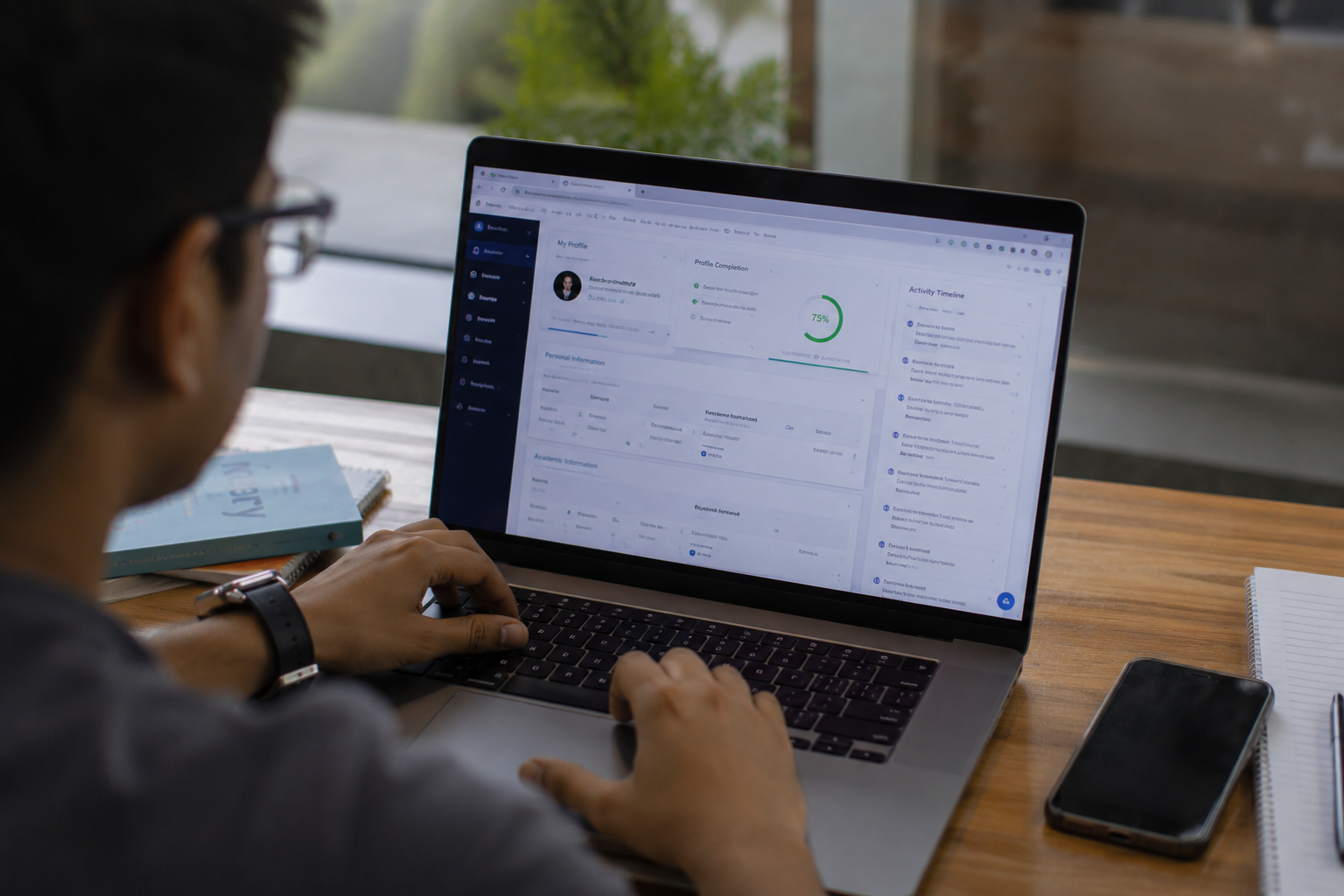
Build for recruiter reading speed, not personal expression
Recruiters do not begin with deep context about who you are. They begin with a screening task. Your profile has to answer basic questions fast:
- What roles is this student suitable for?
- Are they academically eligible?
- What proof exists for their claims?
- How much coaching or verification will be needed before the next stage?
That is why clarity beats volume. A long profile with inflated claims performs worse than a concise profile with sharp, verifiable signals.
Students should aim for thirty-second readability:
- one-line role direction such as software engineering, data analysis, finance operations, or product support
- crisp summaries for projects and internships
- tools and technologies named specifically
- measurable outputs where possible
- no filler phrases like "hardworking," "passionate," or "team player" unless backed by evidence
If a recruiter can understand your strengths in under half a minute, your profile is doing its job.
Turn academics into a decision-ready signal
Academic information should not be left as a raw set of marks. It should help someone understand your consistency and eligibility immediately.
Instead of simply uploading semester numbers and moving on, make sure your record helps answer:
- current CGPA or percentage
- trend over time if there is meaningful improvement
- active backlogs, cleared backlogs, or no-backlog status
- branch, specialization, graduation year, and course type
- notable academic work linked to your target role
For example, a student applying for analytics roles should not stop at listing coursework. They should connect relevant subjects, tools, and projects so the recruiter can see role alignment without guessing.
This is especially important because many employers still use basic filters such as GPA, graduation year, and program relevance during early screening. If those details are missing, formatted poorly, or inconsistent across the profile and resume, the student creates avoidable doubt.
Show proof, not broad claims
Every student says they are interested in technology, business, consulting, design, or analytics. Very few show proof in a way that makes the claim easy to trust.
A strong profile converts statements into evidence:
- "Know Python" becomes a project, GitHub repository, automation task, or data analysis workflow
- "Interested in marketing" becomes campaign work, content metrics, club responsibility, or internship output
- "Good communication" becomes presentation leadership, community role, published work, or event coordination
- "Problem solving" becomes a case competition, hackathon build, research task, or process improvement outcome
The profile should answer one question repeatedly: what has this student actually done that signals readiness for the role they want?
This is also where many students undersell themselves. Academic projects, internships, club work, freelance tasks, and capstone work all count when presented well. The goal is not to sound impressive. The goal is to make competence visible.
Make projects readable like business outcomes
One of the fastest ways to improve a student profile is to rewrite project descriptions. Most project sections are too technical, too vague, or too long.
A better structure is:
- problem or use case
- what you built or executed
- tools used
- measurable result or learning outcome
For example, instead of:
"Built a machine learning model for prediction."
write:
"Built a demand forecasting model using Python, Pandas, and XGBoost to improve week-ahead inventory planning accuracy on a retail dataset."
That version helps the recruiter understand domain, tooling, and applied thinking in one line.
Students targeting non-technical roles should do the same. A campus event, survey project, operations internship, or business case becomes more credible when it shows scope, action, and result.
Keep resume, profile, and external links aligned
Many shortlist losses happen because the resume says one thing, the placement portal says another, and LinkedIn or GitHub says something else entirely.
That mismatch raises avoidable questions:
- Which resume version is current?
- Is the internship real or outdated?
- Are the listed tools actually used?
- Is this project link broken?
Before placement season, students should run a consistency review across:
- profile headline
- resume summary
- academic details
- internship dates
- project titles
- certification names
- portfolio, GitHub, or LinkedIn links
Consistency creates trust. Trust speeds decisions.

Treat responsiveness as part of employability
Profile strength is not just about content. It is also about operational discipline.
Students lose opportunities because they:
- miss assessment windows
- respond late to interview requests
- upload wrong documents
- ignore eligibility clarifications
- fail to confirm availability
In campus hiring, responsiveness is often interpreted as seriousness. A well-prepared student who reacts late can lose ground to a slightly less polished student who is easier to move through the process.
This is one reason digital placement systems matter. When deadlines, tasks, and updates are centralized, students are less likely to miss important actions. But the tool alone is not enough. Students still need the habit of checking updates, completing steps on time, and keeping documents ready.
Run a pre-season profile audit
Before applications open, every student should do one full audit and ask:
- Can a recruiter understand my target roles immediately?
- Do I have proof behind my top three claims?
- Are all academic and eligibility fields accurate?
- Does my resume match the placement profile exactly where it should?
- Are all project and portfolio links working?
- Can I respond to a recruiter request on the same day?
If the answer to any of those is no, the profile is not yet placement-ready.
What a strong placement-ready profile really looks like
A strong profile is not the one with the most information. It is the one that reduces evaluator effort.
That means it is:
- complete enough to clear eligibility checks
- specific enough to show role fit
- verified enough to be trusted
- concise enough to be scanned quickly
- current enough to act on immediately
Tenurin is built around exactly this operating reality. For students, the platform is not just a place to upload a resume. It is a verified professional profile that brings together academics, projects, skills, assessments, and application activity in one workflow. That makes it easier to stay application-ready, not just application-aware.
Placement outcomes often look unpredictable from the outside. In reality, a large part of them is operational. Students who prepare their proof, clarity, and response systems before the rush begins give themselves a real advantage across every drive that follows.